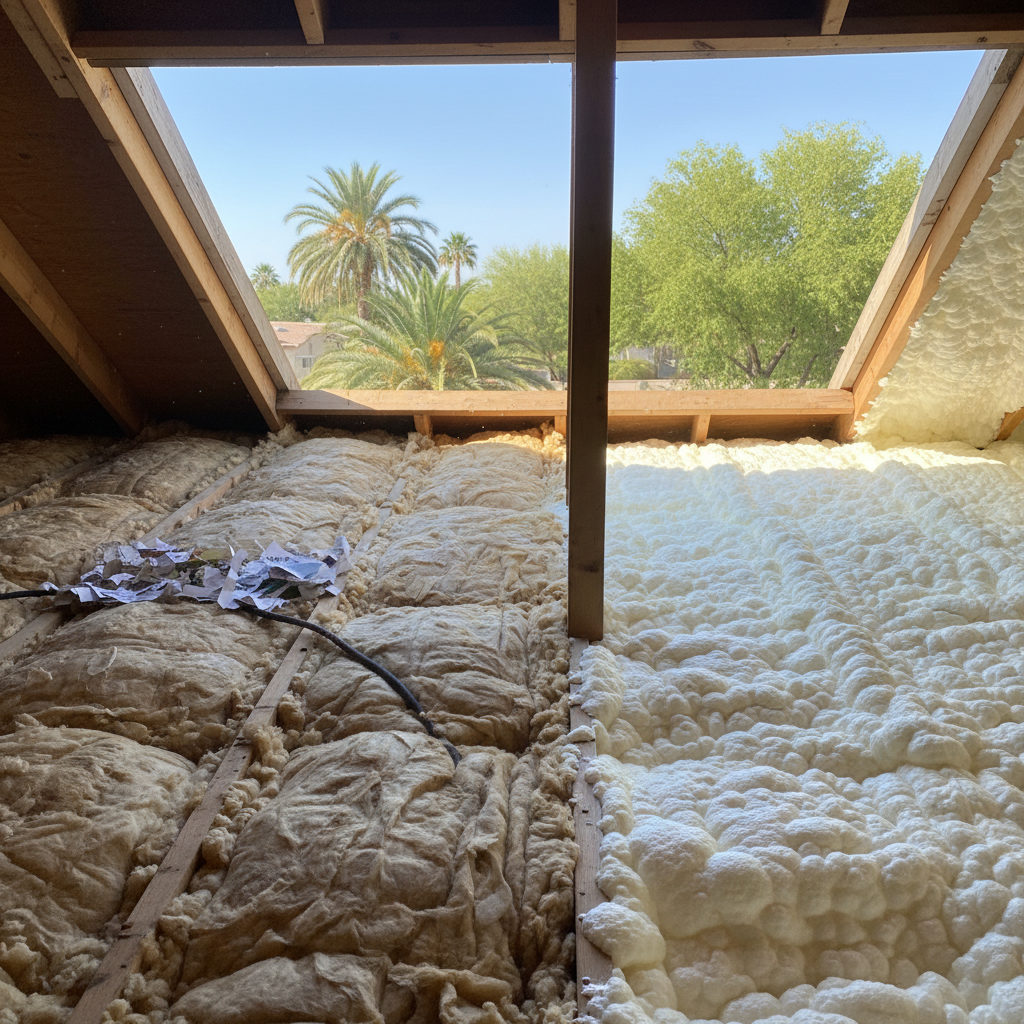
Alright, let's cut to the chase. You're looking into open-cell spray foam for your home, maybe for your attic, walls, or even under the floor. That's a smart move, especially with our Glendale summers. But then you hear terms like 'faced' and 'unfaced' and suddenly it's not so simple. What's the difference, and more importantly, which one should you actually put in your house?
I've been doing this a long time, and I've seen all sorts of insulation jobs across the Valley. Let me break down these two options for you, straight up.
What's Unfaced Open-Cell Spray Foam?
This is probably what most people picture when they think of spray foam. It's just the foam, sprayed directly onto the surface – the underside of your roof deck, the inside of your wall cavities, whatever. It expands, fills every nook and cranny, and then it cures. It's got that soft, spongy texture once it's set.
Cost: Generally, unfaced open-cell is going to be your more budget-friendly option upfront. You're paying for the foam and the labor to apply it, nothing extra.
Application: It's super versatile. We can spray it into all kinds of weird spaces, around pipes, wires, you name it. It creates a seamless air barrier, which is huge for energy efficiency.
Vapor Permeance: This is important, especially in our dry climate. Open-cell foam is vapor permeable, meaning moisture can pass through it. In a hot, dry place like Glendale, that's usually a good thing for allowing building materials to breathe and dry out.
And What About Faced Open-Cell Spray Foam?
Now, this is where things get a little more specific. When we talk about 'faced' spray foam, we're usually talking about open-cell foam that's applied with some kind of facing material already attached or immediately applied over it. The most common facing you'll hear about is an ignition barrier or a thermal barrier. This isn't part of the foam itself, but an additional layer.
Why would you need this? Building codes. In many areas, if spray foam is left exposed in an attic or crawl space – basically, anywhere people might go even occasionally – it needs a protective barrier. This barrier helps slow down the spread of fire. Think of it like drywall for your insulation.
Cost: It's going to cost more. You're paying for the foam application, plus the cost of the facing material, and the extra labor to install it. Sometimes the facing is a special paint, sometimes it's a board material.
Durability & Protection: The facing adds a layer of protection. It can make the foam less susceptible to incidental damage, and of course, it provides that fire safety aspect.
Appearance: If you care about how your attic looks (some people do!), a faced application can look a bit cleaner or more finished, especially if it's a painted barrier.
My Recommendation for Glendale Homeowners
Here's the deal for us in Glendale, AZ. Most of the time, when we're talking about insulating an attic or a crawl space with open-cell spray foam, you're going to need an ignition barrier or a thermal barrier. It's not really an 'option' as much as it is a code requirement if that foam is left exposed.
So, while the foam itself is 'unfaced' when it comes out of the gun, the finished application in an exposed area will effectively be 'faced' with that protective layer. You can't just spray open-cell in your attic and walk away if it's an accessible space, like most attics in older Glendale neighborhoods where people store holiday decorations.
For wall cavities that are going to be covered by drywall, unfaced open-cell is perfectly fine and standard. The drywall acts as your thermal and ignition barrier.
Don't get too hung up on the terminology. What you need to know is that for exposed applications, you'll be getting open-cell foam PLUS a code-compliant barrier. It's not usually one or the other, it's more about understanding that the barrier is a necessary addition for safety and code compliance in certain areas of your home.
When you call Glendale Spray Foam Insulation, we'll walk you through exactly what's required for your specific project and make sure everything is up to snuff. We'll give you a clear quote that includes all the necessary components, so there are no surprises. You want your home to be comfortable and safe, and that's exactly what we aim to deliver.